Head CT Scan
in Bhopal.
Quick, detailed brain and skull diagnostics starting at ₹1,800. Detect stroke, brain bleeding, tumors, and fractures with Bhopal's premier radiology network. Same-day reports.
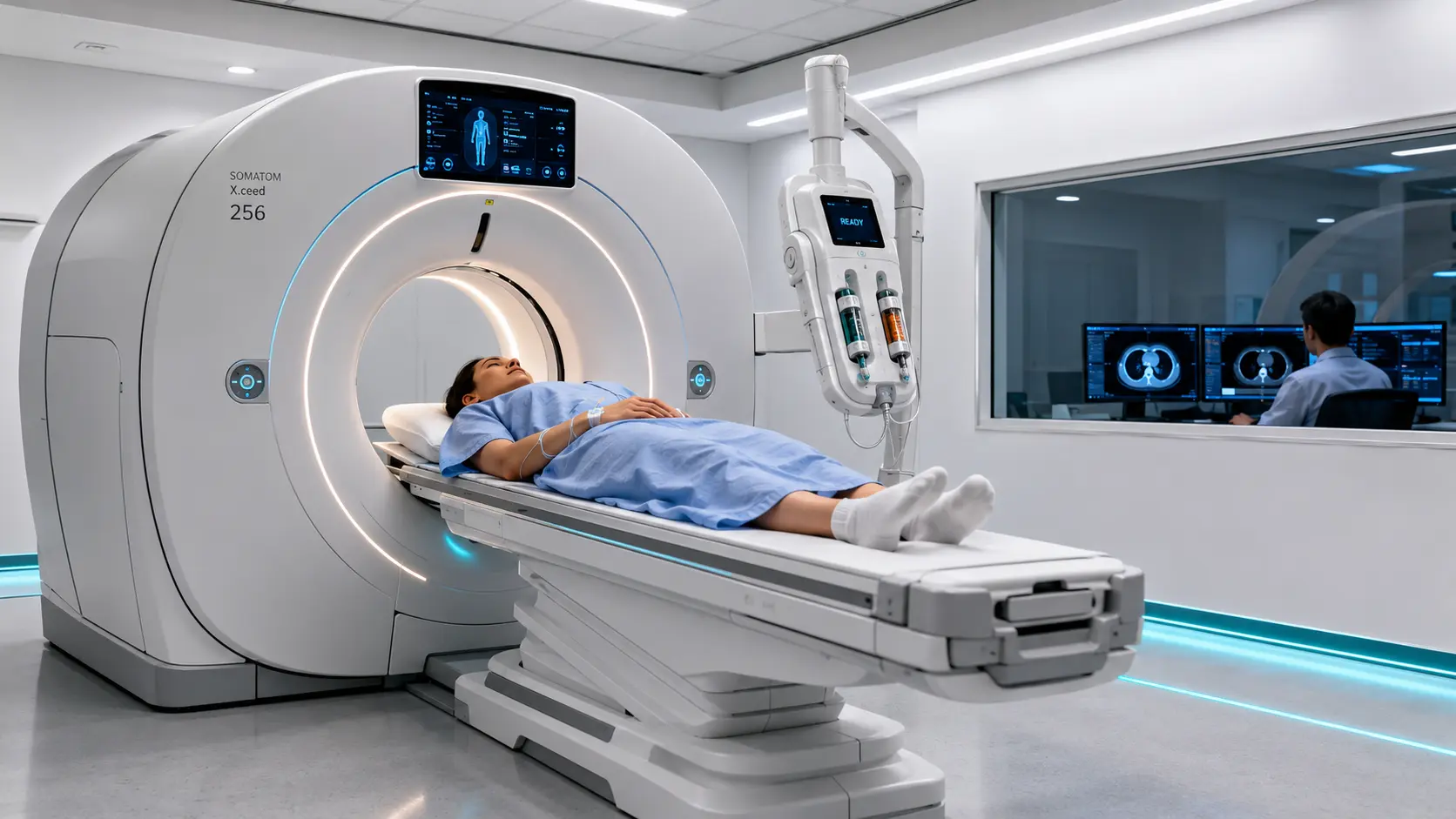
Advanced 128-Slice CT Scanner
Using state-of-the-art multi-slice CT technology to deliver detailed cross-sectional brain images quickly, helping local doctors make immediate, life-saving decisions.
What is a Head CT Scan?
A Head CT (Computed Tomography) Scan uses a rotating X-ray machine and advanced computer processing to create detailed, cross-sectional images ("slices") of your brain, skull, blood vessels, and surrounding soft tissues.
Compared to a standard skull X-ray that only captures bone, a CT scan offers far greater detail. The scan shows different parts of your head based on how hard or soft they are: hard bones look bright white, soft brain parts look grey, and liquids and air pockets look black. New bleeding also shows up as a bright white area, enabling emergency staff to identify strokes and brain hemorrhage indicators in a matter of seconds.
If your doctor needs to check for long-term or subtle nerve problems, they might suggest a Brain MRI Scan instead. MRIs use strong magnetic fields to show soft brain tissues in much greater detail.
How it works
The machine takes many X-ray pictures of your head from different angles. The computer then stacks these images to build a detailed 2D slice or a 3D model, allowing radiologists to look inside the brain layer by layer.
Types of Head CT Scans We Offer
We provide different types of brain scans depending on your doctor's recommendation and symptoms.
Plain CT Brain
No contrast dye is used. It is the first choice for head trauma, accidents, and acute stroke, quickly showing skull fractures, fresh bleeding, and brain swelling.
CECT Brain
A special iodine dye is put into your vein to highlight blood flow. This makes issues like tumors, brain infections, and abscesses show up much more clearly on the scan.
CT Angiography (CTA)
Focuses on mapping the brain's blood vessels. Excellent for identifying vascular problems like brain aneurysms, blockages, narrowing, or abnormal blood vessel tangles (AVM).
CT Perfusion Brain
Measures blood flow through the brain in real-time. It is highly useful during an acute stroke to show which areas of the brain are salvageable and need urgent treatment.
Why Do Doctors Recommend a Head CT Scan?
A head scan is commonly prescribed to evaluate or rule out several brain and neurological symptoms:
What Can a Head CT Scan Detect?
A CT scan is incredibly effective at identifying acute changes, structural abnormalities, and bone conditions:
🧠 Stroke Types
Quickly distinguishes between ischemic stroke (caused by a blocked artery) and hemorrhagic stroke (caused by bleeding). This distinction is critical because treating them requires completely opposite protocols.
🩸 Brain Bleeding
New or active bleeding shows up as high-contrast bright white on the scan. This makes it quick and easy to detect life-threatening issues like epidural, subdural, subarachnoid, or intracerebral hemorrhages.
🧬 Tumors & Cysts
Identifies larger or calcified brain tumors, their location, size, and the pressure they are putting on surrounding brain tissue.
💀 Skull Fractures
Shows bone details clearly, making it easy to identify hairline or complex fractures of the skull bones after trauma.
💧 Hydrocephalus
Detects enlargement of the brain's ventricles filled with excess cerebrospinal fluid, which can cause pressure in the head.
🦠 Infections & Abscesses
Reveals localized brain abscesses, swelling, or meningitis, especially when contrast dye is used to highlight the inflamed tissue.
Head CT Scan Pricing in Bhopal
We offer affordable, transparent rates with no hidden fees. Here is the approximate cost breakdown of different scans:
| Scan Type | Approx. Price Range | Important Notes |
|---|---|---|
| CT Brain — Plain (Non-Contrast) | ₹2,200 – ₹2,500 | Most affordable; best for emergency trauma and stroke |
| CT Brain — With Contrast (CECT) | ₹3,000 – ₹3,500 | IV contrast dye used; requires 4 hours of fasting |
| CT Angiography (Brain Vessels) | ₹5,000 – ₹8,000 | Maps blood vessels; detects aneurysms or AVMs |
| CT Perfusion Brain | ₹6,000 – ₹10,000 | Stroke protocol; maps real-time blood flow in brain |
How to Prepare for a Head CT Scan
Preparing for your head scan is simple, but the steps depend on whether you are getting a plain or a contrast scan.
For Plain CT (Non-Contrast)
- 1You do not need to fast. You can eat and drink normally before the scan.
- 2Wear loose, comfortable clothing without metallic buttons.
- 3Remove all metal items: earrings, necklaces, hairpins, glasses, and hearing aids.
- 4Remember to bring along your physician's referral prescription and any past head scan or brain imaging reports.
- 5Tell the technicians if you have ever had brain surgery or if you have any metal implants inside your body.
For Contrast CT (CECT)
- 1Fast for at least 4 hours before the scan (no food or drinks except water).
- 2Inform your doctor and the staff if you have any iodine or seafood allergies.
- 3Tell the staff about all the medicines you are taking, especially Metformin (a medicine for diabetes).
- 4Inform staff if you have a history of kidney disease (recent Creatinine test is required).
- 5Be sure to notify the imaging staff prior to the scan if there is any chance you might be pregnant.
Step-by-Step Scan Procedure
Knowing what to expect can help you stay relaxed during your scan. Here is how it works:
Registration & referral submission
Submit your physician's prescription note along with any prior brain scan reports at the front desk.
IV line insertion (if contrast)
A small IV cannula is inserted into your arm vein. This is a quick and simple procedure to prepare for the dye injection.
Positioning on the CT table
You will lie flat on your back on a motorized table. Your head will rest comfortably in a padded cradle to help keep it still during the scan.
Scanning (2–5 minutes)
The table slides slowly into the large, ring-shaped CT scanner. It is important to stay completely still. You will hear a quiet whirring sound as the machine takes images.
Contrast injection (if ordered)
If ordered, the contrast dye is injected mid-scan. You may feel a brief sensation of warmth, flushing, or a metallic taste in your mouth. This is completely normal and fades in a minute.
Report collection
Our radiologist will read the scan and write the report. Most partner centres in Bhopal provide printed and digital reports along with films on the same day.
Safety & Potential Risks
We prioritize patient safety. Here is what you need to know about the radiation and contrast risks:
☢️ Radiation Dose
A Head CT scan has a radiation dose of about 2 mSv, which is equivalent to about 8 months of natural background radiation. The risk of harm is very low, and the diagnostic benefit almost always outweighs this minor risk.
💉 Contrast Reactions
Fewer than 1% of patients experience mild reactions to the iodine dye, such as a temporary rash or itching. Severe allergic reactions are extremely rare, and our partner clinical teams are trained to handle them immediately.
🤰 Pregnancy
CT scans are generally avoided during pregnancy, especially in the first trimester, to protect the developing baby from radiation. Please inform the staff if you are or think you might be pregnant.
🩺 Kidney & Diabetes
The contrast dye is cleared by the kidneys. If you have kidney disease or are taking Metformin for diabetes, your kidneys could experience temporary strain. Disclose these conditions so we can adjust the protocol safely.
Frequently Asked Questions.
Is a Head CT Scan painful?
How long does the scan take?
When will I get my report?
Do I need a doctor's prescription?
Is CT or MRI better for the brain?
Other Diagnostic Scans We Offer
MRI Bhopal provides a comprehensive range of advanced imaging services. Explore the scan that best fits your diagnostic needs.
Brain MRI
Radiation-free neurological imaging starting ₹3,500
Knee MRI
Precision ligament & cartilage imaging from ₹4,500
CT Scan
128-slice ultra-fast body imaging from ₹1,500
PET-CT Scan
Molecular-level cancer & cardiac imaging
Ultrasound
4D sonography & Color Doppler from ₹500
Ready to
Book Your Scan?
Book your Head CT scan today and get same-day appointment slots, free pick & drop, and premium reporting.
Same-Day
Report Delivery
Free Transit
Pick & Drop Offered
128-Slice
High-Resolution CT
Expert
Radiologist Network